

NASA mission medals offer a straightforward way to collect space history. They are compact, easy to catalogue, simple to display, and available across many budgets. A focused Apollo collection can begin with one mission and expand gradually without requiring specialized equipment or a large display cabinet.
This guide covers the difference between commemorative medals and official mission artifacts, the information to record, practical display methods, and three Apollo medals currently listed by Raging Canucks.
What Is a NASA Mission Medal?
A mission medal is a numismatic or commemorative object made to recognize a specific spaceflight. It may include:
- Mission name
- Launch or return date
- Astronaut names
- Mission insignia
- Spacecraft imagery
- Lunar module or command module designs
- Historical text
The term “mission medal” can describe several different types of objects. Some were produced for astronauts, NASA personnel, or other participants. Others were made by private mints and sold to the public as commemorative memorabilia.
That distinction matters.
The three Raging Canucks products featured in this guide are commemorative bronze medals. They are not mission-used artifacts, space-flown Robbins medallions, spacecraft components, or documented pieces removed from Apollo hardware.
They commemorate Apollo missions through their designs and inscriptions. They should be catalogued and displayed as commemorative medals.
Commemorative Medal vs. Official Mission Artifact
A commemorative medal has a historical connection through subject matter. It celebrates or records a mission, astronaut, spacecraft, or event.
An official mission artifact has a more direct connection. Depending on the item, that connection may include:
- Documented spaceflight
- Use by the crew
- Use during training
- Assignment to a NASA facility
- A documented relationship to a spacecraft or mission program
- Provenance from an astronaut, employee, museum, or established archive
For example, some Apollo Robbins medallions were associated with astronaut flight programs and were flown on missions. Those pieces belong to a different collecting category than a public commemorative bronze medal.
NASA and museum references can help establish this distinction. Start with NASA’s Apollo 9 mission page and the National Air and Space Museum collection record for an Apollo 13 Robbins medallion.
Do not assume that a NASA subject, astronaut name, or mission date proves that a medal was flown. Record only what the item and its documentation support.
Apollo 9: A Strong Starting Point
Apollo 9 launched on March 3, 1969. NASA identifies the crew as James A. McDivitt, David R. Scott, and Russell L. Schweickart. The mission tested the complete Apollo spacecraft system in Earth orbit, including the lunar module.
The Apollo 9 Moon Mission Commemorative Bronze Medal is dated March 3, 1969 and features McDivitt, Scott, and Schweickart.
Product Record
- Title: Apollo 9 Moon Mission Commemorative Bronze Medal
- Type: Commemorative bronze medal
- Mission: Apollo 9
- Date shown: March 3, 1969
- Subjects: James A. McDivitt, David R. Scott, Russell L. Schweickart
- Listed price: $14.99
- Status: Commemorative item
- Action: View product
Apollo 9 is a practical entry point because it represents an important testing phase before the lunar landing missions. It also gives a collection a clear starting date and a crew-focused design.
When cataloguing this medal, record the mission name exactly as shown, the date, the listed material, the astronaut names, and any text or imagery visible on the front and reverse.
Apollo 12: A Lunar Landing Mission
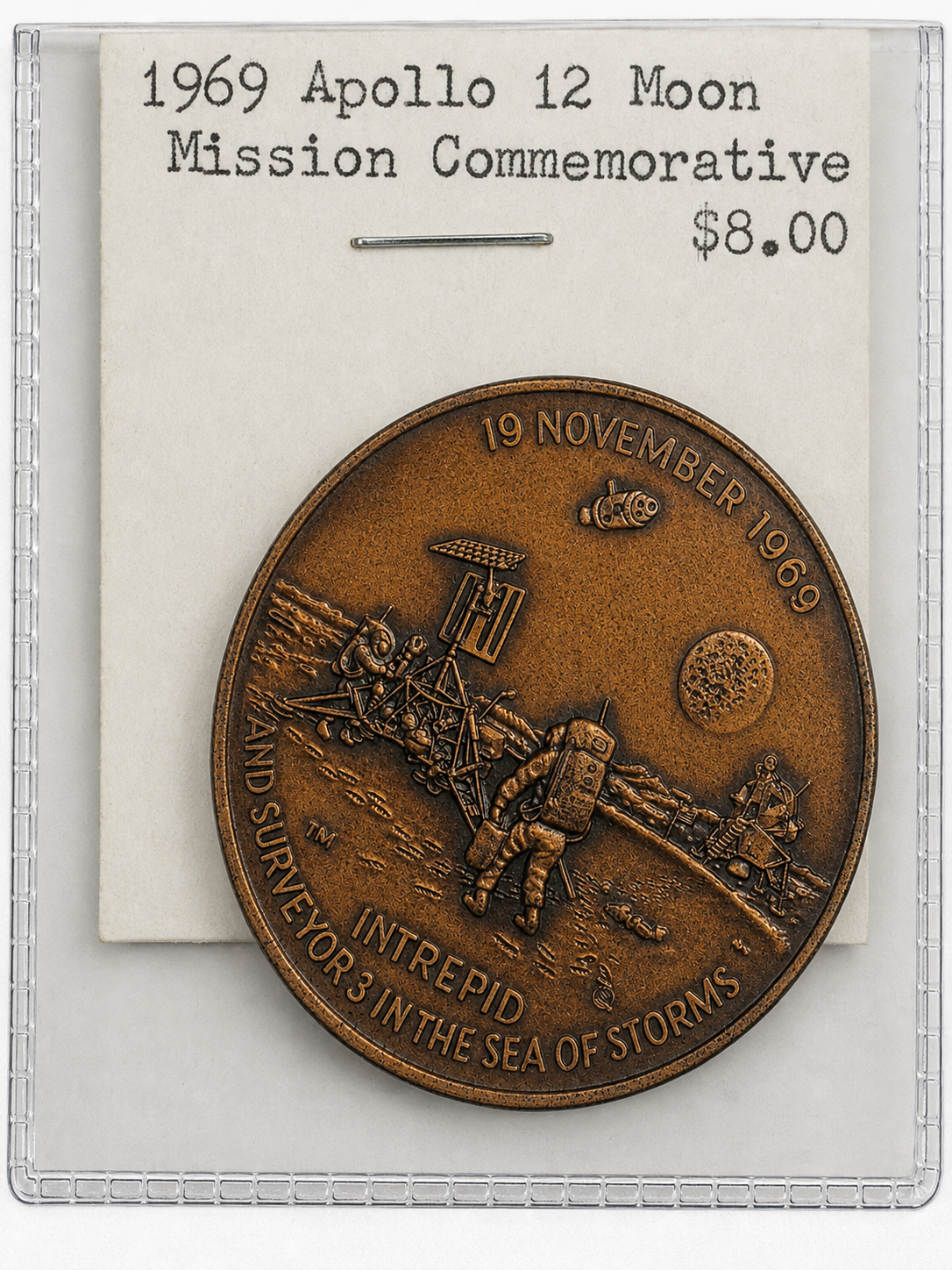
Apollo 12 was the second crewed mission to land on the Moon. It launched in 1969 and is represented by the 1969 Apollo 12 Moon Mission Commemorative Bronze Medal.
The product is described as a vintage commemorative bronze medal recognizing NASA’s second crewed Moon landing mission.
Product Record
- Title: 1969 Apollo 12 Moon Mission Commemorative Bronze Medal
- Type: Commemorative bronze medal
- Mission: Apollo 12
- Year shown: 1969
- Subject: Second crewed Moon landing mission
- Listed price: $14.99
- Status: Commemorative item
- Action: View product
This medal pairs naturally with Apollo 9 because the two pieces show different phases of the program. Apollo 9 focused on testing Apollo hardware in Earth orbit. Apollo 12 represents the continuation of the lunar landing effort.
Product Image
Apollo 13: Mission, Date, and Return
Apollo 13 launched in April 1970 and is widely associated with the crew’s safe return after the mission was interrupted. NASA provides additional historical resources through its Apollo program archive.
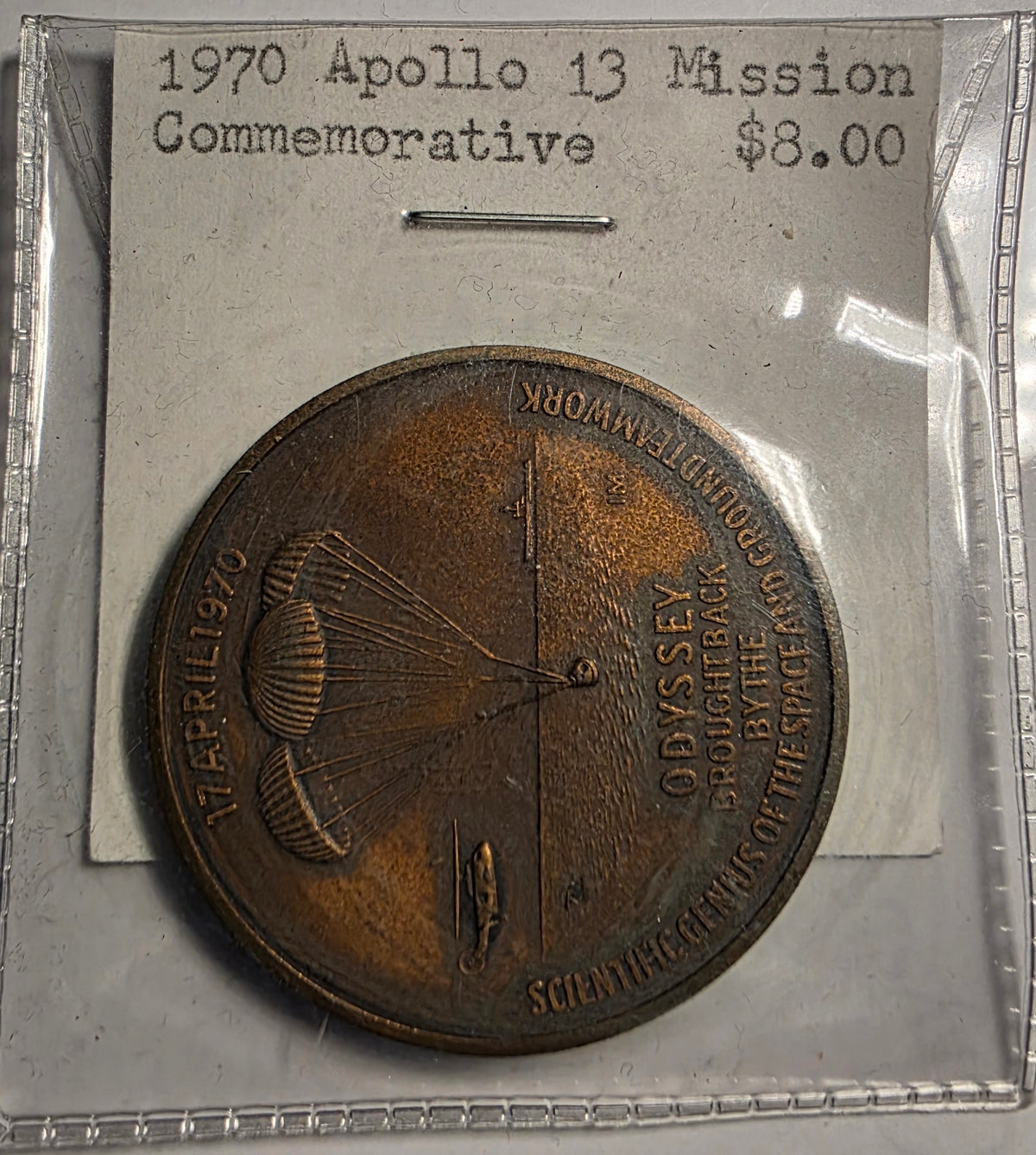
The 1970 Apollo 13 Mission Commemorative Bronze Medal is dated April 17, 1970 and features the Odyssey command module returning to Earth.
Product Record
- Title: 1970 Apollo 13 Mission Commemorative Bronze Medal
- Type: Commemorative bronze medal
- Mission: Apollo 13
- Date shown: April 17, 1970
- Subject: Odyssey command module returning to Earth
- Listed price: $14.99
- Status: Commemorative item
- Action: View product
Apollo 13 demonstrates why collectors should record the subject shown on a medal instead of relying only on the mission name. A design focused on the returning command module emphasizes the recovery aspect of the mission.
Do not describe this product as a spacecraft component or flown artifact. The verified product description identifies it as a commemorative bronze medal.
Product Image
What to Record in a Collection Log
A collection log prevents details from being lost and makes it easier to compare similar pieces.
Use one entry per medal. Include:
Mission
Record the full mission name and number.
Example:
- Apollo 9
- Apollo 12
- Apollo 13
Date
Record the date shown on the medal or product description. Distinguish between a launch date, return date, anniversary date, and year-only reference.
Use the original format where practical. If the medal says April 17, 1970, record that date instead of shortening it to 1970.
Subject
Describe the main design element.
Examples:
- Astronaut portraits
- Mission crew
- Lunar module
- Command module
- Mission insignia
- Return to Earth
Material
Use the verified material description. The three featured products are listed as bronze medals.
Do not infer a specific alloy, purity, plating, or manufacturing process unless it is documented.
Condition
Use neutral, consistent terms:
- Uninspected
- Very good
- Light surface wear
- Visible marks
- Edge wear
- Packaging present
- Packaging absent
Photograph the front, reverse, and edge when possible. Include the packaging if it forms part of the item’s presentation.
Provenance
Provenance means the documented ownership or history of an item. For a public commemorative medal, provenance may be limited or unavailable. Record that plainly.
Possible notes include:
- Purchased from a Canadian collectibles store
- Original packaging included
- Previous owner unknown
- No supporting documentation
- Product description retained
Avoid adding claims that cannot be verified. A mission date does not establish that the medal was present during the mission.
How to Display NASA Mission Medals
Medals are small, but they benefit from organized presentation.
Use Individual Holders
Choose archival-safe coin capsules, display easels, or holders designed for metal collectibles. Avoid adhesives, loose tape, and materials that may leave residue.
Keep Contact Limited
Handle medals by the edge when possible. Fingerprints and oils can affect the surface over time. Cotton or nitrile gloves may be useful when handling several pieces, but avoid dropping or gripping the medal too tightly.
Use a Timeline
A simple left-to-right arrangement works well:
- Apollo 9
- Apollo 12
- Apollo 13
Add a small label under each item with the mission, date, subject, and material. Keep labels separate from the medal surface.
Control the Environment
Choose a dry indoor location away from direct sunlight, high humidity, heating vents, and rapid temperature changes. Do not polish a vintage medal unless its care requirements are understood. Cleaning can change the surface and remove original finish.
Build a Small Themed Collection
A beginner does not need to collect every Apollo issue. Choose one organizing principle and maintain it.
Possible themes include:
- Apollo 9 through Apollo 13
- Bronze commemorative medals
- Astronaut-focused designs
- Spacecraft designs
- Mission dates from 1969 and 1970
- Apollo testing and lunar landing milestones
The three featured Raging Canucks medals create a compact Apollo 9 to Apollo 13 group:
- Apollo 9 for spacecraft testing and crew identification
- Apollo 12 for a crewed lunar landing
- Apollo 13 for the Odyssey command module’s return to Earth
This structure keeps the collection focused while leaving room for future additions.
For shoppers comparing collectibles Canada options, NASA medals also function as practical collectible gift ideas. They suit recipients interested in space history, vintage memorabilia, science, engineering, or mission design. The Raging Canucks search page provides a starting point for related collectibles and unusual gift items.
Final Checklist
Before adding a NASA mission medal to a collection, confirm:
- Mission name
- Date or year
- Main subject
- Material
- Condition
- Packaging
- Provenance
- Exact product description
- Whether the item is commemorative or mission-used
For this Apollo group, the classification is clear. The Apollo 9, Apollo 12, and Apollo 13 products listed above are commemorative bronze medals. They provide accessible entry points for building a focused NASA collection without confusing commemorative memorabilia with official mission artifacts or spacecraft components.