

Buying UFC autograph cards can be one of the most enjoyable parts of collecting MMA. A signed card connects a fighter, a specific set, and often a memorable era of the sport in one compact collectible. The challenge is knowing whether the autograph is genuinely hand-signed, officially issued, or properly authenticated.
That matters whether you are shopping for UFC cards in Canada, building a signed memorabilia collection, or buying a gift for an MMA fan. Before you send payment, take a few minutes to check the card, the listing, and the seller.
Here is a practical collector-to-collector guide to evaluating UFC autograph cards and signed pieces.
Start by identifying what kind of autograph you are buying
Not all signed UFC items are authenticated in the same way. The first question is whether you are looking at a pack-issued autograph card or a signed piece of memorabilia.
A pack-issued autograph card comes from a licensed trading card product. The card company arranged for the fighter to sign either the card itself or a sticker that was later placed on the card. These products usually have manufacturer branding, a set name, a card number, and an authenticity statement printed on the back.
A signed glove, photograph, poster, or other item is different. It may have been signed at an appearance, private signing, event, or through a memorabilia company. In that case, the item’s authentication paperwork, hologram, certification number, and provenance become much more important.
The distinction is simple:
- Trading card autograph: Check the manufacturer, set, card number, authenticity language, and serial numbering.
- Signed memorabilia: Check the chain of ownership, certificate of authenticity, hologram, and third-party verification.
On-card versus sticker autographs
One of the first details collectors notice is whether the autograph is on-card or applied to a sticker.
An on-card autograph is signed directly on the card surface. It generally gives the card a more integrated appearance because the signature is part of the original card presentation.
A sticker autograph is signed on a clear label that is later attached to the card. Sticker autos are still legitimate autographs when they are issued by the licensed manufacturer. The presence of a sticker does not automatically make a card suspicious.
Look closely at the signature area in the listing photos. On a sticker autograph, you may be able to see the edge of the transparent sticker, especially where it catches light. On an on-card autograph, the ink sits directly against the card’s finish.
You are looking for evidence of real ink rather than a printed facsimile. Natural signatures can show changes in pressure, small variations in line thickness, slight pauses, and differences in the way the ink reflects light. A signature that looks perfectly flat and printed, or a listing that uses terms such as “facsimile,” “reprint,” or “pre-printed signature,” should not be treated as a genuine autograph.
Do not try to authenticate a signature based on appearance alone. Fighters sign thousands of items, and signatures naturally change over time. The card’s issue history and authentication are stronger evidence than comparing one signature to a random image online.
Read the back of the card
The back of a UFC autograph card often contains some of the most useful information.
Look for:
- The manufacturer’s name, such as Topps or Panini
- The product line and release year
- The card number
- An official autograph guarantee or authentication statement
- Serial numbering, if the card is numbered
- Copyright and licensing information
A legitimate pack-issued autograph card will commonly include language explaining that the autograph has been certified or guaranteed by the manufacturer. The exact wording varies by product, so compare the card with other examples from the same set or consult a reputable checklist.
Also check whether the card’s front and back belong together. Incorrect fonts, spelling errors, poor-quality logos, strange borders, or a card number that does not match the set are reasons to slow down.
An authenticity statement is useful, but it is not a substitute for buying from a reliable source. Counterfeiters can reproduce printed card designs, so the seller, photographs, and item history still matter.
Serial numbering helps, but it is not proof by itself
Serial numbering is an important feature on many UFC cards. A number such as 118/209 means the card is identified as number 118 from a stated print run of 209. The number should be cleanly applied and consistent with the product’s design.
The Tito Ortiz 2024 Topps Chrome UFC Hall of Fame Gold Refractor Auto /50 HFA-TOR is listed as a serial-numbered card to 50, with an on-card autograph and a Near Mint condition description. The number is useful for identifying the card, but remember that serial numbering confirms the card’s place in a production run. It does not independently prove that the signature is genuine.
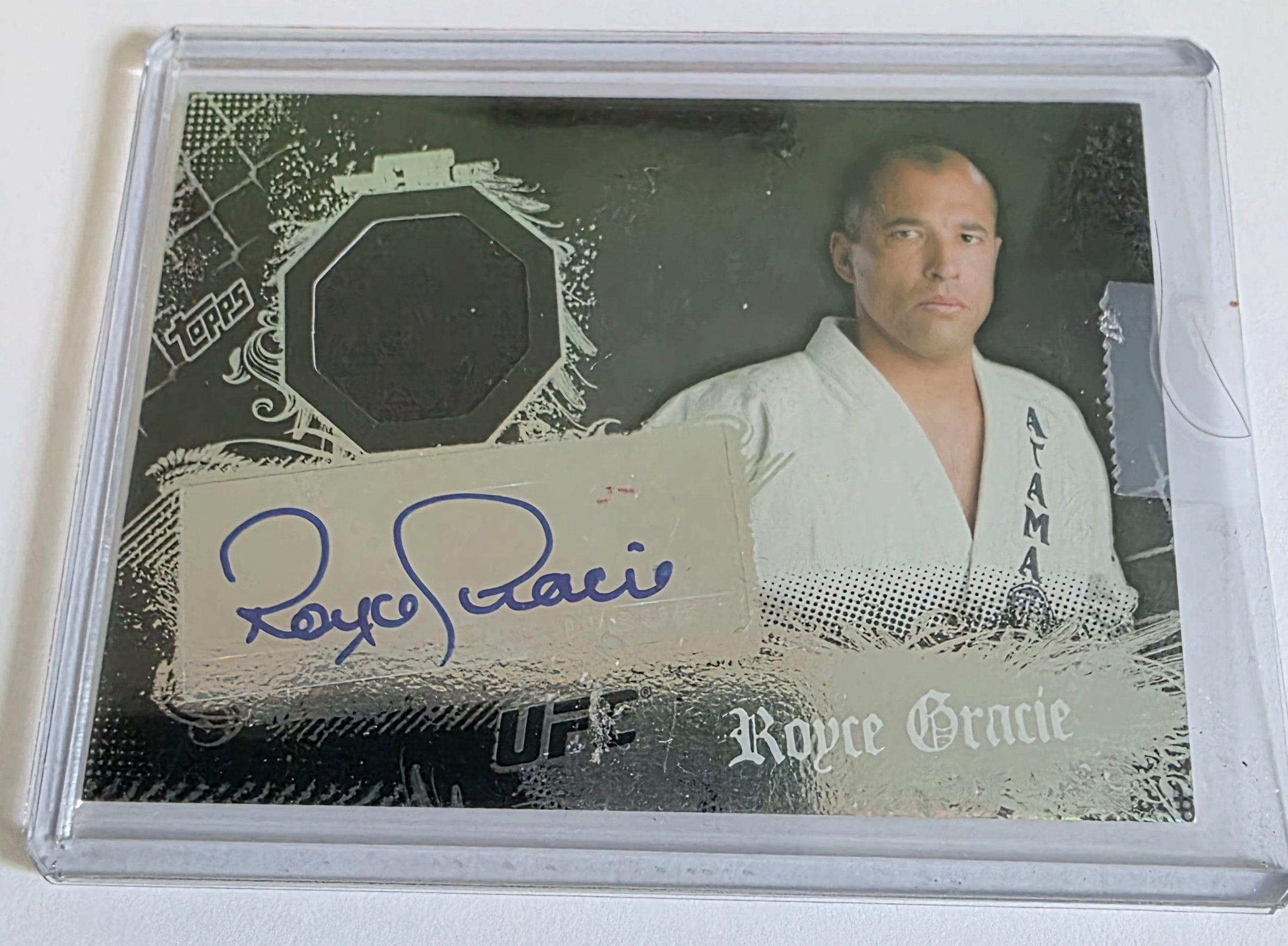
The Royce Gracie 2010 Topps UFC Main Event Autograph Relic #1 is another example of a card with several identifying features. The listing describes an authenticated on-card signature, an event-used memorabilia element, and Near Mint condition. Those details give a collector multiple points to review rather than relying only on the autograph’s appearance.
When evaluating a serial-numbered card, compare the number’s font, location, foil treatment, and formatting with other cards from the same set. A number that looks added later, crooked, or inconsistent deserves more investigation.
Understand what Near Mint means
Condition and authenticity are separate questions.
A card can have a genuine autograph and still have corner wear, surface scratches, edge chipping, print defects, or poor centering. Conversely, a card can look clean while still requiring better authentication.
Near Mint generally suggests a card with strong overall visual condition and limited handling wear. Before buying, inspect the available photos for:
- Soft or damaged corners
- Whitening along the edges
- Scratches or cloudy areas on chrome surfaces
- Creases, dents, or indentations
- Fading, smudging, or uneven autograph ink
- Off-centering or print lines
The Ben Rothwell 2013 Topps UFC Knockout Autograph #118/209 is listed as numbered 118/209 and Near Mint. The Rich Franklin 2009 Topps UFC Round 2 Fighter Autographs #FA-RF is also listed as Near Mint. These condition descriptions help set expectations, but they are not the same as a professional grading-company designation.
If condition is important to you, ask for additional close-up photographs before buying a raw card. A protective holder can help prevent future damage, but it does not improve the card’s original condition.
For signed memorabilia, provenance matters more
Signed memorabilia requires a different level of questioning because it may not have been issued through a card manufacturer.
Take a signed glove as an example. The Georges St-Pierre signed UFC glove is described as an official black UFC MMA glove signed by GSP in silver ink. It is a physical memorabilia piece, not a pack-issued card.
Before buying a signed glove or similar item, ask:
- Who witnessed or arranged the signing?
- Is there a certificate of authenticity?
- Does the certificate identify the item clearly?
- Is there a tamper-evident hologram?
- Does the hologram have a matching number on the paperwork?
- Can the certification number be checked through the authenticator?
- Does the seller show photographs of the actual item?
A certificate of authenticity is only as useful as the organization behind it. Look for documentation from a reputable third-party authentication company or an established memorabilia dealer. A generic certificate with no issuer, no certification number, and no way to verify it offers limited protection.
For claims such as “signed in person” or “fight-used,” ask for specific supporting details. Event information, signing photographs, receipts, or a documented chain of ownership are more useful than vague statements in a listing.
Watch for these red flags
Whether you are shopping locally or online, be cautious when you see:
- A price far below comparable examples without an explanation
- Only one blurry photograph
- No image of the card’s back
- No close-up of the signature
- Stock images instead of a photograph of the actual item
- Vague phrases such as “believed authentic”
- A COA with no identifiable issuer
- A hologram that cannot be verified
- Incorrect UFC, Topps, or Panini branding
- A seller who refuses reasonable questions
- Pressure to pay outside a protected checkout system
Low prices are not automatic proof of a fake. A card may be inexpensive because of the fighter, set, condition, or collector demand. The concern is when an unusually low price appears alongside poor photos and incomplete information.
A quick checklist for Canadian collectors
Before buying UFC autograph cards or signed memorabilia in Canada, use this process:
- Confirm the manufacturer, set, year, and card number.
- Check the back for the manufacturer’s autograph guarantee.
- Determine whether the autograph is on-card or sticker-applied.
- Verify serial numbering against the product’s known format.
- Inspect corners, edges, surface, and autograph clarity.
- For signed memorabilia, request provenance and authentication details.
- Verify a third-party certification number whenever possible.
- Confirm that the listing shows the actual item.
- Review the seller’s reputation and return policy.
- Keep the receipt, listing photographs, messages, and authentication paperwork.
The safest approach is not to chase the cheapest listing. It is to buy the item with the clearest identity, strongest documentation, and most transparent seller.
For more UFC cards, signed pieces, action figures, and other MMA collectibles, browse the Raging Canucks MMA collection. A careful buying process helps you build a collection you can enjoy for what each piece represents, not just what the listing claims.